

There’s no denying that AI adoption is accelerating across teams.
With the use of AI in the workplace starting out as small-scale experimentation, we’re rapidly hurtling towards a new era where it’s becoming standard practice, with one study showing as many as 88% of respondents say their company uses AI for at least one business function. Naturally this brings a lot of opinions about not only adapting ways of working, but also causing concern around whether AI could ‘replace’ entire job roles, or functions.
With some fundamental strengths of AI being around problem solving and pattern recognition, paired with its ability to write code, generate content, and aid decision making, one area whose future is hotly debated is Quality Assurance. QA roles span across all industries, from video games to tech, cited as bridging the gap between the build and the standard that reaches the consumer. Being such a diverse role, our focus will be on quality assurance in the email and SMS testing space- where some see this era as the beginning of the end for QA, while others see it as the moment it becomes more important.
Why does AI impact email and SMS QA?
Email and SMS testing is, at its core, a way of systematically analysing how your product communicates. That structured nature is exactly why some see it as a candidate for AI takeover. QA work follows clear patterns. It checks systems, validates behaviour and surfaces issues before they reach users. From the outside, it can look like a simple step between creation and fix, which leads to the assumption that AI can take it on end-to-end.
In practice, it is rarely that straightforward. QA is not just a checkpoint. It is where decisions get made. Teams use it to determine what is acceptable to ship, what needs further work and what signals a deeper issue across the system. That requires more than pattern recognition. It relies on understanding how systems behave in real conditions and how users actually interact with them.
There is also a layer of work that cannot be easily defined. QA engineers move beyond predefined paths. They follow hunches, test unexpected scenarios and connect behaviour across emails, SMS and the wider journey. That all comes from experience and context, not just data.
Collaboration is another part of this- QA sits between marketing, product and engineering, translating technical issues into real impact and helping teams decide what to do next.
This is where the human element comes in. It is not just about finding issues; it's about interpreting them, prioritising them and deciding whether they represent a minor edge case or a systemic risk. AI can help surface signals, but the responsibility for making those calls still sits with people.
AI-created systems still need QA
AI is now involved in creating much of what gets tested, now generating code, content and entire communication flows, impacting the role of QA. Where QA once focused on running tests, it now plays a bigger role in defining what quality looks like. That shift matters because generated outputs can carry wider implications, where a small issue in an email or SMS message can affect compliance, customer trust or core product journeys.
There are also signs that repeated AI-driven changes, especially in code, can introduce deeper issues if left unchecked. Over time, small adjustments can compound into more serious vulnerabilities, with one study finding a 37.6% increase in critical vulnerabilities after just five iterations of AI-based code improvement.
This is where ownership becomes critical- AI can produce outputs and surface potential issues, but it does not take responsibility for outcomes. Someone still has to decide whether something is ready to ship, whether the risk is acceptable and what needs to change, hence the need for human QA.
The role of exploratory testing
Some of the most valuable work in QA does not come from predefined scripts. Humans notice when something feels off, test in ways that were not planned, follow unexpected paths and question results that technically pass but do not quite make sense. That comes from experience rather than data alone.
In communication testing, this becomes even more important- emails and SMS messages are part of wider journeys. Users might open messages late, click links out of order or interact across devices, and issues often appear across those journeys rather than in isolated steps.
AI testing relies on structured scenarios, generated data and controlled environments, which is hugely beneficial of course, but can’t capture the nuance and unpredictability of real behaviour. Human QA brings an understanding of audience, timing and context that is difficult to replicate, and it’s also what allows teams to connect signals across systems, rather than treating each output in isolation.
The combination becomes the new normal
For all of these reasons and more, the future of QA is not defined by replacing people with AI, it is shaped by how the two work together.
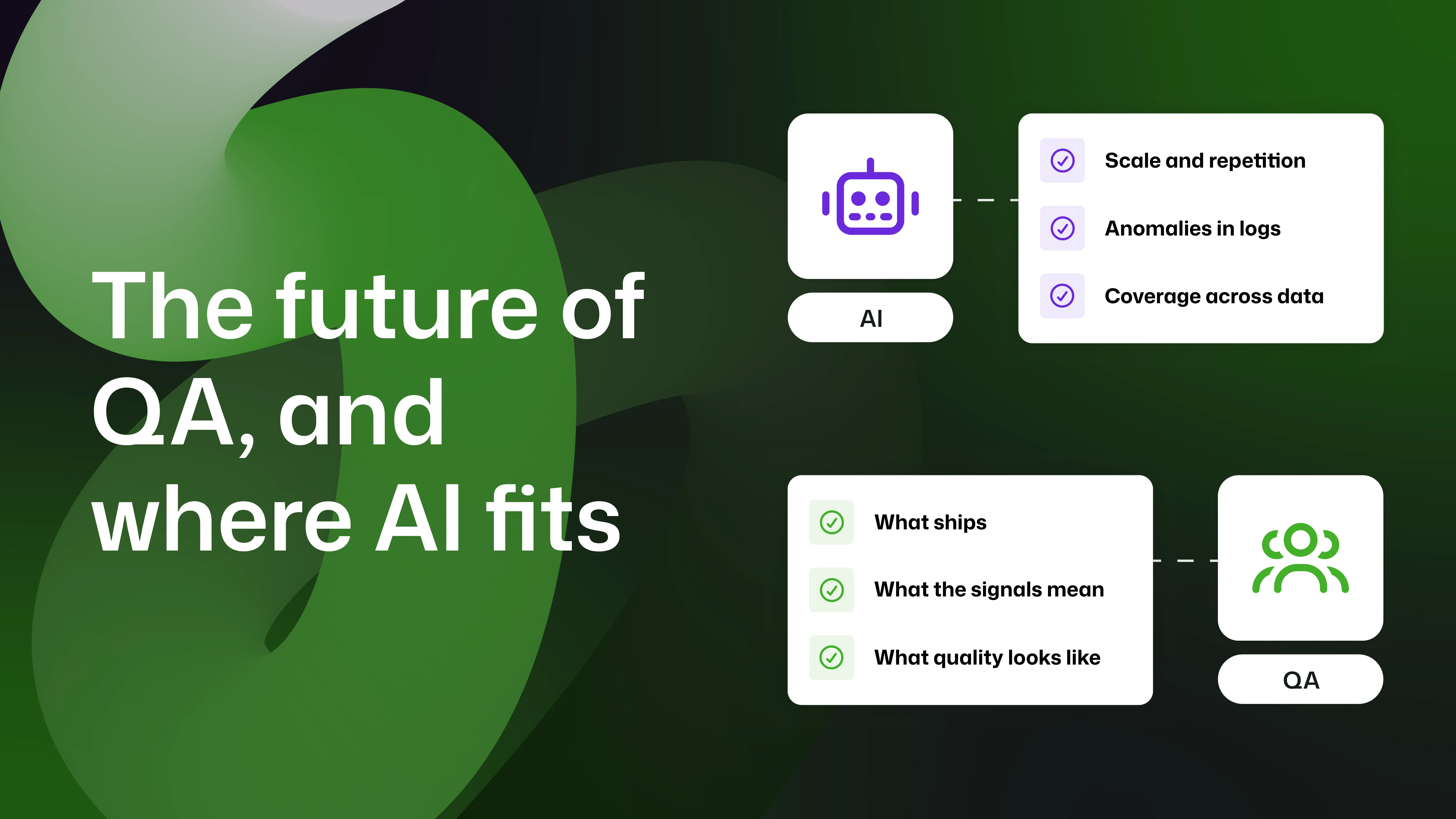
AI is already helping teams increase coverage and process large volumes of data, highlighting high-risk areas based on historical patterns, surface anomalies in logs and performance data, and identify visual issues across interfaces. It can also support adaptive testing, where content is generated and iterated dynamically.
This changes how QA teams spend their time, where less effort goes into running repetitive checks, and more focus goes into direction.
- QA becomes responsible for:
- interpreting signals from automated systems
- deciding what is acceptable to release
- refining how testing evolves over time
AI can handle scale and repetition, while QA defines standards and ensures those systems stay aligned with how products should behave in the real world.
The future
We can assume that AI will continue to change how QA works, along with a host of career paths besides, but not all of these are negative; it can increase speed, expand coverage and introduce new ways of testing.
What it will not do is remove the need for people who understand systems and users at the same time. QA has always been about more than finding issues. It is about deciding what those issues mean and what action to take. That remains a human responsibility, even as the tools around it evolve.
The future of QA is not about replacement, it’s about how teams combine human judgement with machine-driven scale.