

Email testing has gone from an optional extra to a core part of test infrastructure for most products. So, when are free tools enough and when does it make sense to pay for something more reliable?
Free email testing tools are easy to find. Search for ways to test emails in development and you will quickly come across names like MailHog or Mailpit. They are simple to set up, cost nothing, and give fast feedback.
As products grow, email becomes part of the product itself. Account sign-ups, one-time passcodes, and multi-factor authentication all rely on emails working as expected. At that point, free tools start to show their limits.
What free email tools are actually designed for
Tools like MailHog and Mailpit have a clear purpose.
MailHog acts as a local SMTP server so developers can confirm that an application sends an email during development. Mailpit provides disposable inboxes so teams can receive messages without creating real accounts. They are optimised for convenience and speed, making them useful for quick checks and basic validation during development.
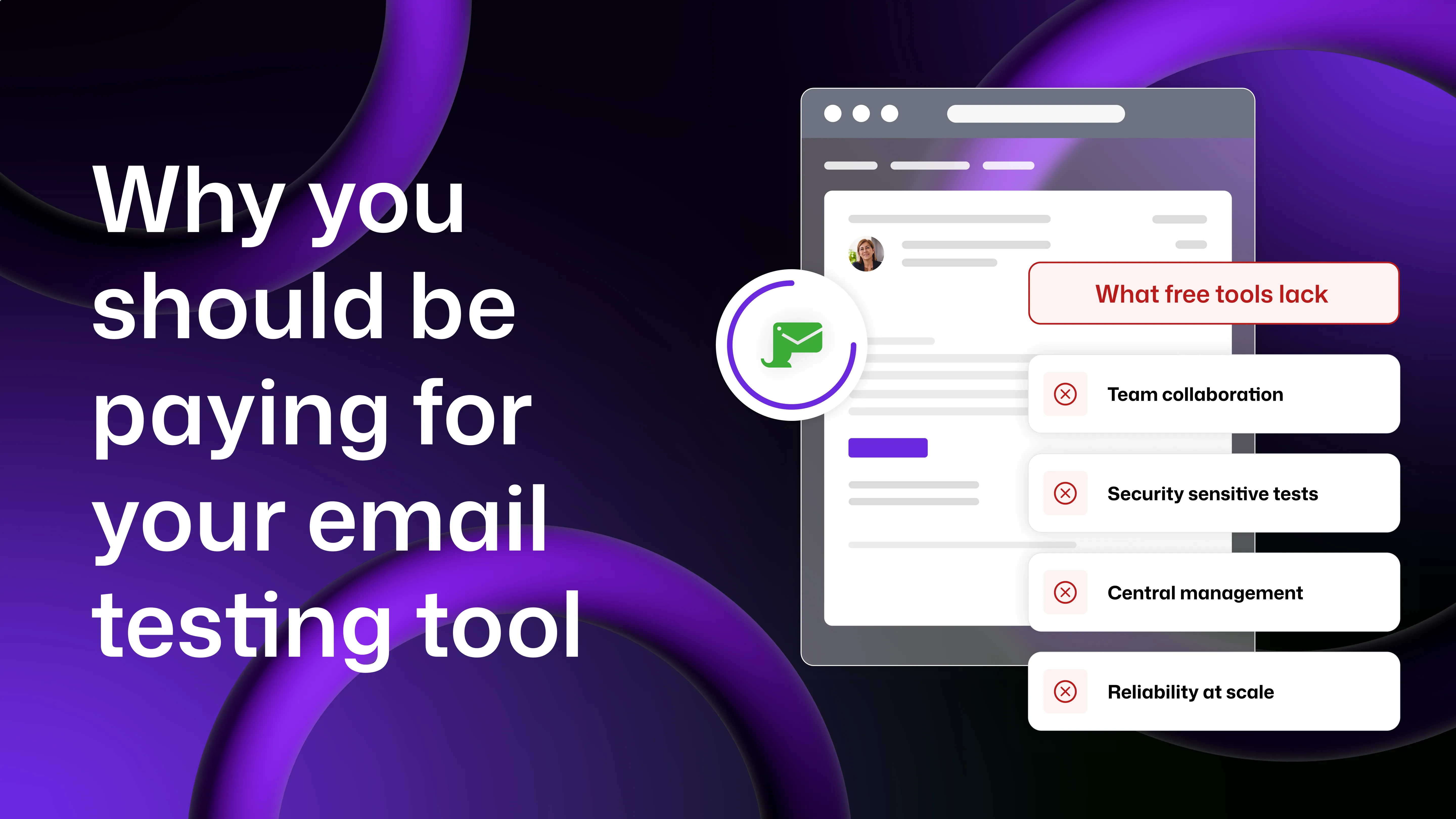
What they are not designed for is full testing coverage- they don’t aim to handle:
- Collaboration across teams
- Centralised team management (such as hierarchal permissions)
- Security-sensitive use cases
- Long-term reliability - so your testing can’t be scalable or reliable
They are developer tools, rather than testing platforms, so the problems start when teams expect them to cover both roles.
The hidden cost of manual checks
Manual email checks can be a valid and involved way to test your emails; someone triggers a workflow, opens an inbox, scans the content, and signs it off. There will always be a place for manual testing, however complexity increases when you’re no longer working with one environment and limited testing scope.
More environments, more edge cases, and more contributors all put pressure on the process, leading to results which become inconsistent and harder to trust. Naturally, modern teams need more than visibility- they need bulk tests, on comprehensive issues, done in a way where issues are replicable. That means being able to:
- Assert on email content, links, and structure
- Extract codes and tokens for test flows
- Run checks inside CI pipelines
- Fail tests automatically when something is wrong
Unfortunately, free tools do not focus on this level of automation… but paid platforms do.
Security credentials change the equation
There is also a clear shift when authentication enters the picture.
Testing a welcome email manually can be inconvenient, but may also be prone to error, making testing a password reset or one-time passcode that way risky. This is especially true considering authentication emails are part of your security model, where timing, accuracy, and expiry all matter.
Most free tools are not built for this level of testing; they don’t provide structured ways to extract codes, validate links, or assert behaviour across environments. They also tend to lack isolation and auditability, which becomes more important in security-related testing.
At this stage, paying is not about convenience, more reducing uncertainty and maintaining compliance.
Meeting the needs of your team
As teams grow, email testing becomes shared responsibility where, at a minimum, the Product team needs confidence in user journeys, QA needs coverage and Engineering needs repeatability. This means shared inboxes and manual checks are no longer enough.
Teams start to need:
- Isolated environments for different test runs
- Consistent behaviour across builds
- Clear ownership of failures
- Confidence that tests are not interfering with each other
Free tools may be able to support parts of this, but by design they cannot manage it end to end.
Reliability is priceless
If an email behaves inconsistently during testing, it slows teams down. If that same issue reaches production, it creates user-facing problems.
While you may consider the typical outcomes of these to include failed sign-ups, broken password resets and delayed or missing authentication codes, what they really result in is:
- Broken customer trust (particularly pertinent in regulated industries)
- Higher volume of support tickets and complaints (for your team to handle)
- Embarrassing PR situations (the kind people don’t forget)
Paid platforms aim to reduce these risks by giving consistent, repeatable results and clearer visibility into failures.
The bottom line
Overall, free tools are a good starting point, and certainly have their place in the QA world, where most teams might benefit from using them early on.
However, they are not enough once email testing gains its permanent place in your flows. When users depend on emails to complete key actions, testing needs to move beyond manual checks and basic visibility, so paying for an email testing platform isn’t about features, but taking responsibility for something your product depends on.